Delivery
From audit to autopilot: six steps to automating a business process
Most automation projects in small firms start in the wrong place. Someone sees a demo, buys a licence, and then goes looking for work to point it at. Twelve months later the licence renews and nobody can say what it saved.
The firms that get real hours back do it the other way round. They start with the work, and they only let a machine run something on its own once it has shown it gets the answer right. In practice that comes down to six steps, taken in order.
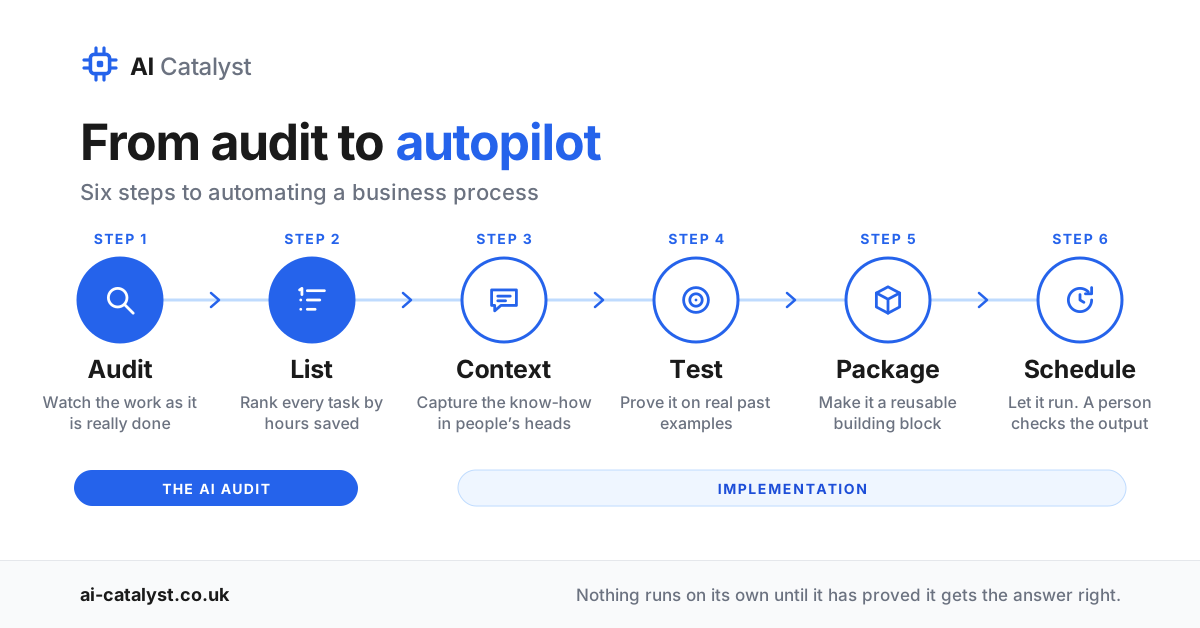
1. Audit: watch the work as it is really done
Not the process document, and not how the manager believes it happens. Sit with the people doing the work for a few hours. Note every time someone copies something from one screen to another, re-keys a number, chases an email, or checks one spreadsheet against another.
This is where most of the value is found, and it is the step most often skipped. The workaround one person invented three years ago and never told anyone about is often the best candidate in the building.
2. List: write down every candidate and rank it
Turn what you saw into a list of discrete, repeatable tasks — "draft the weekly stock report", not "improve operations". Against each one, estimate the hours it takes a month and how hard it would be to hand over. Then sort.
The top of the list should be dull: high volume, clear inputs, and a result someone already checks. Quoting a bespoke job is a poor first candidate. Turning a supplier's PDF price list into your costing sheet is a good one.
3. Context: get the know-how out of people's heads
An AI tool is only as good as what it is told. For each task on the shortlist, capture what the person doing it knows: the rules, the exceptions, which customers always need special handling, and what a good result and a bad one look like.
The quickest way is often to ask them to talk it through while they do it, and record it. People explain their work far better out loud than in writing, and a twenty-minute recording becomes the brief.
4. Test: decide what right looks like before going live
Collect a set of real past examples where you already know the correct answer — last month's quotes, a batch of enquiries that were handled well, a report someone signed off. Run the new process against them and compare.
This is the step that separates a working system from a convincing demo. It gives you a number rather than an impression, and something to re-run every time the process or the underlying tool changes. In AI circles these are called evaluations, or evals. On a shop floor you would call it first-article inspection.
5. Package: make it a reusable building block
Once a task passes its tests, write it up as a defined, repeatable unit: the instructions, the reference material, the worked examples and the checks. Current AI tools call these skills. The point is that the task no longer lives in one person's chat history. Anyone in the team can run it and get the same result, and when it needs improving, it is improved in one place.
6. Schedule: let it run, and check the output
Only now does it run on its own — every morning, every Friday, or every time a new order lands. The person who used to do the task reviews the result instead, which takes minutes rather than hours.
Keep the tests from step four running alongside it. Tools update, suppliers change their formats, and a process that was right in March can drift by June. A scheduled task with no checks is just a faster way to be wrong.
Where to start
Take one task through all six steps before starting a second. The first one teaches you more about your own business than any amount of planning, and it gives you a real saving to point at when the next one needs approving.
The AI Audit covers steps one and two: a ranked list of where automation will pay in your business, with the hours and costs against each. Implementation takes the top items through the remaining four.